scorpion
The scorpion is the agent of crisis that shatters the idyllic opening of John Steinbeck's novella and sets the entire tragic plot in motion. Its appearance transforms Kino's world from one governed by the harmonious Song of the Family to one haunted by the Song of Evil, and its sting creates the desperate need that drives Kino to find the pearl that will destroy him.
Appearance and the Scorpion Sting
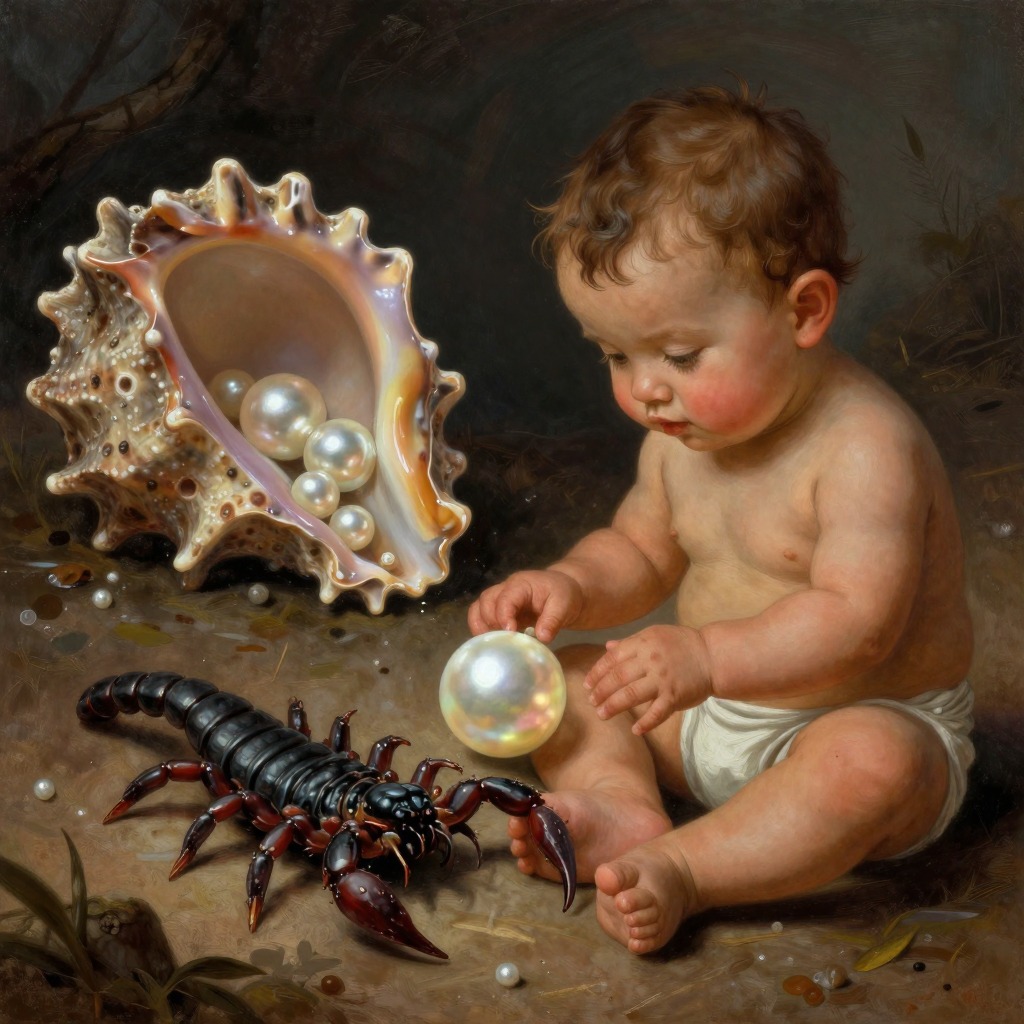
The scorpion first appears in the second chapter of the novella, during a morning of perfect domestic peace. As a streak of sunlight falls on the hanging box where the infant Coyotito lies, Kino and Juana freeze at a tiny movement: a scorpion is moving slowly down the rope that suspends the box from the roof support. Its stinging tail is straight out behind it, but it can whip up in a flash of time. Kino's breath whistles in his nostrils, and in his mind a new song arises—the Song of Evil, the music of the enemy, of any foe of the family, a savage, secret, dangerous melody. Beneath it, the Song of the Family cries plaintively. The scorpion moves delicately down the rope toward the box. Juana repeats an ancient magic under her breath and mutters a Hail Mary between clenched teeth. Kino glides across the room, his hands in front of him, palms down, his eyes fixed on the scorpion. Beneath it, Coyotito laughs and reaches up his hand. The scorpion senses danger when Kino is almost within reach; it stops, and its tail rises up over its back in little jerks, the curved thorn on the tail's end glistening. Kino stands perfectly still, unable to move until the scorpion moves. It feels for the source of the death coming to it. Kino's hand goes forward very slowly, very smoothly. The thorned tail jerks upright, and at that moment the laughing Coyotito shakes the rope and the scorpion falls. Kino's hand leaps to catch it, but it falls past his fingers, lands on the baby's shoulder, and strikes. Snarling, Kino catches it, rubs it to a paste in his hands, throws it down, and beats it into the earth floor with his fist. Coyotito screams with pain. Kino's teeth are bared, fury flares in his eyes, and the Song of the Enemy roars in his ears.
Consequences of the Sting
The scorpion's sting has immediate and severe physical consequences for Coyotito. Juana finds the puncture with redness already starting from it. She puts her lips down over the puncture, sucks hard, and spits, sucking again while Coyotito screams. The screams bring the neighbors, who crowd into the brush house. The word is passed: "Scorpion. The baby has been stung." Everyone knows about the scorpion. An adult might be very ill from the sting, but a baby could easily die from the poison. First, they know, will come swelling and fever and tightened throat, then cramps in the stomach, and then Coyotito might die if enough of the poison has gone in. The stinging pain of the bite goes away, and Coyotito's screams turn to moans. Juana, who is usually obedient and respectful, surprises everyone by demanding that Kino go to get the doctor. The doctor, a wealthy man who never comes to the brush houses, refuses to treat the baby when Kino can only offer eight small, misshapen seed pearls as payment. The doctor's servant tells Kino, "The doctor has gone out. He was called to a serious case." Kino, in a rage, strikes the doctor's gate with his fist, splitting his knuckles. The scorpion sting thus exposes the brutal class divide and the callousness of the powerful, and it creates the desperate need for money that leads directly to Kino's discovery of the great pearl.
The Scorpion as a Symbol of Evil
The scorpion functions as the primary symbol of the evil that the pearl will later embody. The Song of Evil that first sounds in Kino's head when he sees the scorpion becomes the music that accompanies every subsequent act of violence and betrayal. The scorpion's sting is the first intrusion of danger into the family's peaceful world, and it foreshadows the greater evils to come. The doctor, when he finally comes to treat Coyotito, uses the threat of the scorpion's poison to manipulate Kino. He tells Kino that the scorpion sting can have a curious effect: "Sometimes, my friend, the scorpion sting has a curious effect. There will be apparent improvement, and then without warning—pouf!" He claims that the poison has gone inward and will strike soon, and he gives the baby a capsule of white powder that makes him violently ill. The doctor's exploitation of the scorpion sting is a direct parallel to the way the pearl buyers will later exploit Kino's hope. The scorpion's poison is literal; the pearl's poison is metaphorical, but both are deadly. Juana, when she tries to convince Kino to throw the pearl away, cries, "This pearl is like a sin! It will destroy us," and the scorpion is the original sin that sets the tragedy in motion. Even after the family flees into the mountains, the scorpion's legacy persists. Kino, looking into the pearl, sees Coyotito's face "thick and feverish from the medicine"—the medicine the doctor gave to counteract the scorpion's poison. The scorpion's sting is the wound that never heals, the original injury that the pearl was supposed to cure but instead makes incurable.
The Scorpion's Narrative Role
The scorpion is the engine of the plot. Without its sting, Kino would never have sought the doctor, never have been humiliated, never have gone diving for the pearl with such desperate hope. The scorpion creates the need that the pearl is meant to satisfy, and it is the scorpion's poison that the doctor pretends to treat, establishing the pattern of exploitation that will define Kino's relationship with the town. The scorpion also establishes the thematic opposition between the natural world and the human world of greed and cruelty. The scorpion is a natural predator, acting on instinct; the doctor and the pearl buyers are human predators, acting out of avarice. The scorpion's sting is a random accident; the evils that follow are the result of human choice. The scorpion, in the end, is the only honest enemy in the story—it strikes openly, and its poison can be sucked out. The human enemies are far more dangerous because they hide their poison behind smiles and false concern. The scorpion's role is thus both literal and symbolic: it is the physical cause of the crisis and the moral emblem of the evil that the pearl will unleash.